
Can art help us see the bigger picture?
Professor Su Ballard's research shows that art helps us think and feel, and could hold the key to encouraging people to take action on climate change.
“Art is the most important thing,” says Su Ballard, Professor of Art History and Environmental Humanities at Te Herenga Waka—Victoria University of Wellington.
“Humans have always made art. Scientists even define humanity by the moment that we started making images that visually interpreted what we saw going on around us,” she explains. “Art tells us about ourselves. It expresses who we are and it communicates between people and across time.”
We live in a world of images and we live amidst visual culture. These days virtually everyone is carrying around an infinite number of images in their pocket—it’s crucial that we are able to think about those critically, to understand them and decode them.
Professor Su Ballard
Professor of Art History and Environmental Humanities
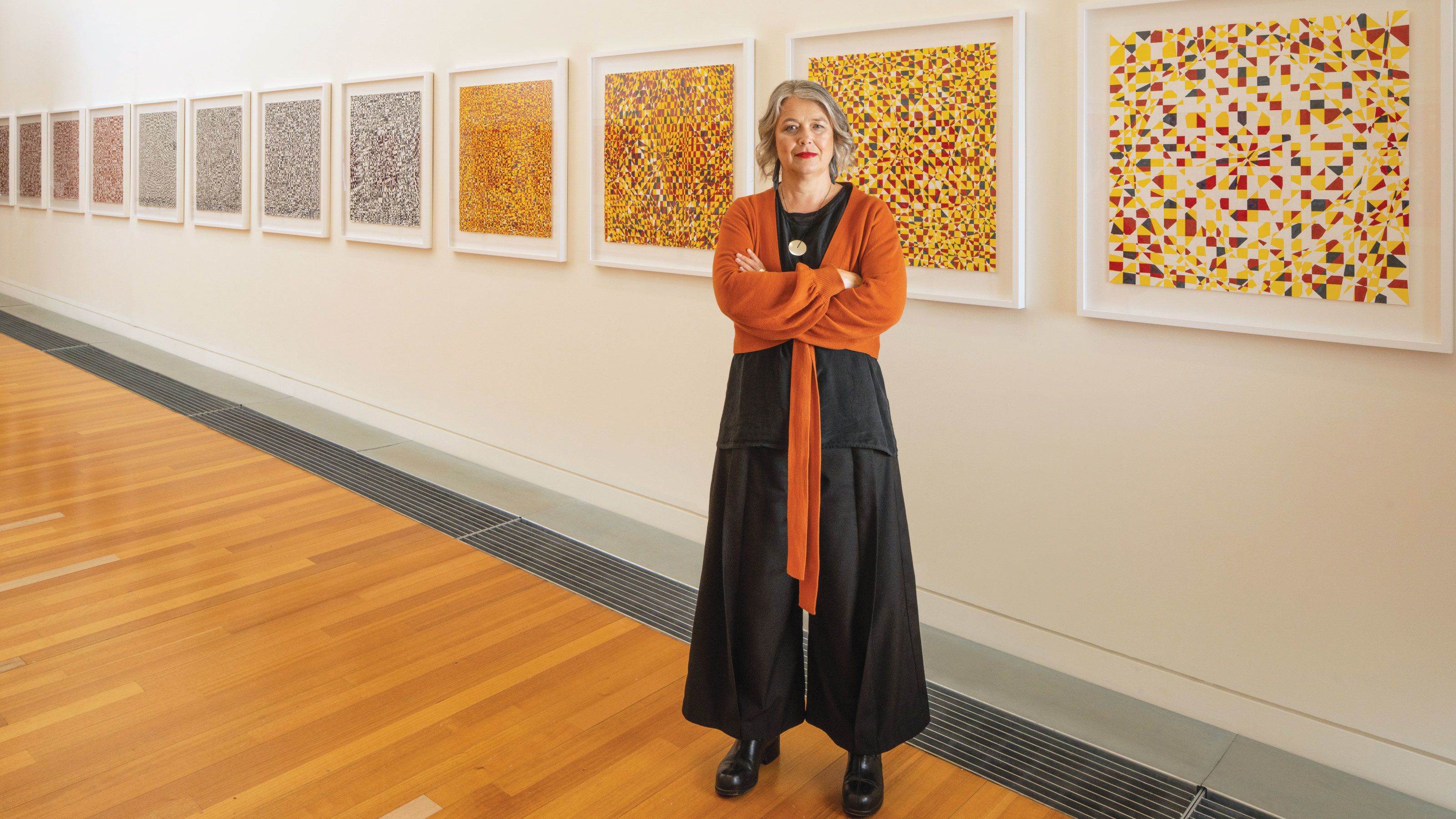
Professor Ballard says her role as an art historian is to communicate what artworks are saying and doing, to offer a critical lens on the images, objects, and sensory experiences that humans create.
“That’s the strange space I occupy as an art historian. My practice is writing. I don’t make the art but I write about the art, to explain it and bring us closer to it. I try to tell the stories that accompany it; the narratives that help express the impact of that work,” she explains. “I try to imagine a world without those stories and it’s not a very nice place. We need artworks, and the histories and narratives that go with them, in order to be able to think into the future.”
She says art has played a pivotal role in some of the biggest changes humanity has seen. “I teach a first-year course called Art, Revolution and Crisis, where we look at art across time, especially in those key moments in history. When you think about events as diverse as the French Revolution or the bombing of the Rainbow Warrior here in Aotearoa, art is there. It’s representing these events, it’s questioning them.”
In many cases, art is contributing to, and transforming, the way we understand events—not just documenting but actually adding knowledge to them.
Professor Su Ballard
Professor of Art History and Environmental Humanities
Art and the environment
Much of Professor Ballard’s research is focused on the relationship between art and the environment.
“Art is made in context—it doesn’t sit separate from its environment. It’s made in the context of society, culture, and the natural world. Art draws a triangle between these three things—it brings them together, meaning it can reflect people’s values or concerns, and politically promote change in relation to the environment.”
There’s a long history of environmental art as a movement, says Professor Ballard.
“In the 1960s and 70s, environmental art meant being out in nature or in the wilderness and engaging with it as a material that could be manipulated by humans. There’s been a huge change in thinking about how we care for the environment and how we then reflect that back, rather than the interventions into the environment that characterised earlier environmental art.”
She says many artists are considering the sustainability of the materials used to create their works, and some are even auditing their own work for carbon emissions.
“[Icelandic-Danish artist] Olafur Eliasson took 12 huge cubes of ice off a glacier and placed them in the centre of Paris in the form of a melting ice clock—it had the immediate impact of horror as people could watch this glacier ice melting. But the more interesting aspect of this work was the carbon audit the artist undertook as part of it. He audited the shipping, and the fossil fuels used in extracting the ice from the glacier. It added an extra interesting and challenging layer to the work.”
Can art help tackle the climate crisis?
A big motivator for Professor Ballard to specialise in environmental art was the Intergovernmental Panel on Climate Change meeting in Paris in 2015. “There was a lot of talk among the scientists at the time along the lines of, ‘we’re doing everything we can do, so why is no one paying any attention?’ A call was put out to artists, writers, and other creative practitioners, asking us to step up and do something.”
My work is based in the belief that art helps us think, it helps us feel, it helps us understand the world around us right now. And that’s the part the scientists are struggling with—they’ve got all the incredible facts and the significant data but they’re having a hard time getting people to feel something about what they’re saying.
Professor Su Ballard
Professor of Art History and Environmental Humanities
In 2025, Te Herenga Waka became the first university in Aotearoa to offer a major in Environmental Humanities (EHUM) as part of the Bachelor of Arts and the new Bachelor of Environment and Society qualification. Environmental Humanities courses are focused on what creative practices—art, literature, film, theatre and media—add to our understanding of the environment.
“There is a clear need for the arts to be part of the bigger conversation, to help communicate crucial scientific messages. That means we need people who can write critically and describe and engage with the environment,” she says.
“We often feel something about art before we even know what we’re thinking. So art is not the only tool that can inspire action, but it’s definitely part of the process. We need many ways to approach problems that affect us all and so, if the problem is climate change then we need everyone’s tools. We need tools of critical observation and we need tools of imaginative interpretation. We need tools that help us see the problem.”
From lecture hall to gallery wall
Professor Ballard co-curated a public exhibition at the New Zealand Portrait Gallery Te Pūkenga Whakaata that demonstrates the relationship between people and the environment. Reclaimed Land: Tāngata, Tiriti, Taiao, brings together work that is united around ideas of caring for—and being part of—the environment.
“My co-curator Israel Randell and I have worked to select pieces that express relationships with the environment, particularly whenua, and the way artists have illustrated their own histories and whakapapa and connections to the environment,” she says.
“These works challenge the idea that a portrait can only be of a human image—they tell the human story of the environment and remind us that to look after the land is to look after ourselves.”
Find out more about research at Te Kura Kōmanawa School of Arts and Media